Line up everyone in this room's sensory thresholds — touch pressure, two-point discrimination, proprioception, vestibular tolerance, interoceptive accuracy, auditory sensitivity, visual overwhelm — and you won't find a cluster. You'll find a spread. Wide enough that the person next to you, doing the same job, with the same license, is functionally living in a different sensory world. That's not a curiosity. It's the thing this class is actually about.
Most sensory assessment training treats "normal" as a fixed target and deviation as a problem to correct. This class starts from the opposite premise: normal is a range, most of your clients (and most of you) sit somewhere on it, and good clinical work depends on locating where — not on assuming everyone processes touch, pressure, sound, and movement the way you do.
How you'll find out where you sit
This class is built on direct experience, not lecture. You'll go through the same testing your clients would:
Interoceptive mapping — blindfolded, you draw where you believe your own organs sit. The gap between the drawing and reality is the lesson.
Sensory deprivation under load — blindfolded and ear-plugged, you navigate a simple obstacle course. What your body does when two major input channels go dark tells you something no questionnaire can.
Skin elasticity and phenotype testing — a real, hands-on look at individual variation in tissue response.
Startle response testing — your reflexive reaction to unexpected stimulus, measured rather than assumed.
Two-point discrimination and acuity testing — the actual, classic measure of tactile resolution, done properly.
Every result gets added to a live class wall map, seven axes wide, with everyone's dot plotted on every axis. By the end of the day you're not looking at your own scores in isolation — you're looking at the full spread of a room full of licensed, competent massage therapists, and seeing just how wide "normal" actually is.
Why it matters for your clients
If the range in a room of trained therapists is this wide, the range across your client base is wider still. A client who flinches at pressure you'd consider light isn't being dramatic — they may simply sit at a different point on the touch-pressure axis than you do. A client who seems oddly unbothered by deep work may be at the other end of it. This class gives you a framework for treating that variation as real, measurable, and worth assessing directly, rather than reading it as compliance, resilience, or fragility.
Who it's for
Licensed massage and manual therapists at any experience level. No prior sensory-science background required — every concept is taught through the activity that demonstrates it, not through slides alone.
Learning Outcomes
Perform standard two-point discrimination and tactile acuity testing to establish an individual's touch-pressure and texture-tolerance thresholds.
Demonstrate an interoceptive mapping exercise and interpret the gap between a client's perceived and actual internal body awareness.
Administer a sensory-deprivation task (vision and hearing occluded) and identify the resulting compensatory and protective behavioral responses.
Differentiate typical variation in sensory processing (touch, proprioception, vestibular tolerance, interoception, startle reflex) from presentations that warrant referral, using population-range data gathered in class.
Apply individual sensory threshold findings to adjust treatment approach — pressure, pacing, and environmental setup — for a specific client rather than defaulting to a standardized technique.
IN-PERSON
8-hour NCBTMB approved continuing education class (NY Sponsorship approved and CE Broker approved)
Open to all healthcare practitioners licensed in Manual/Massage Therapy
Course ID(s): CE4027954
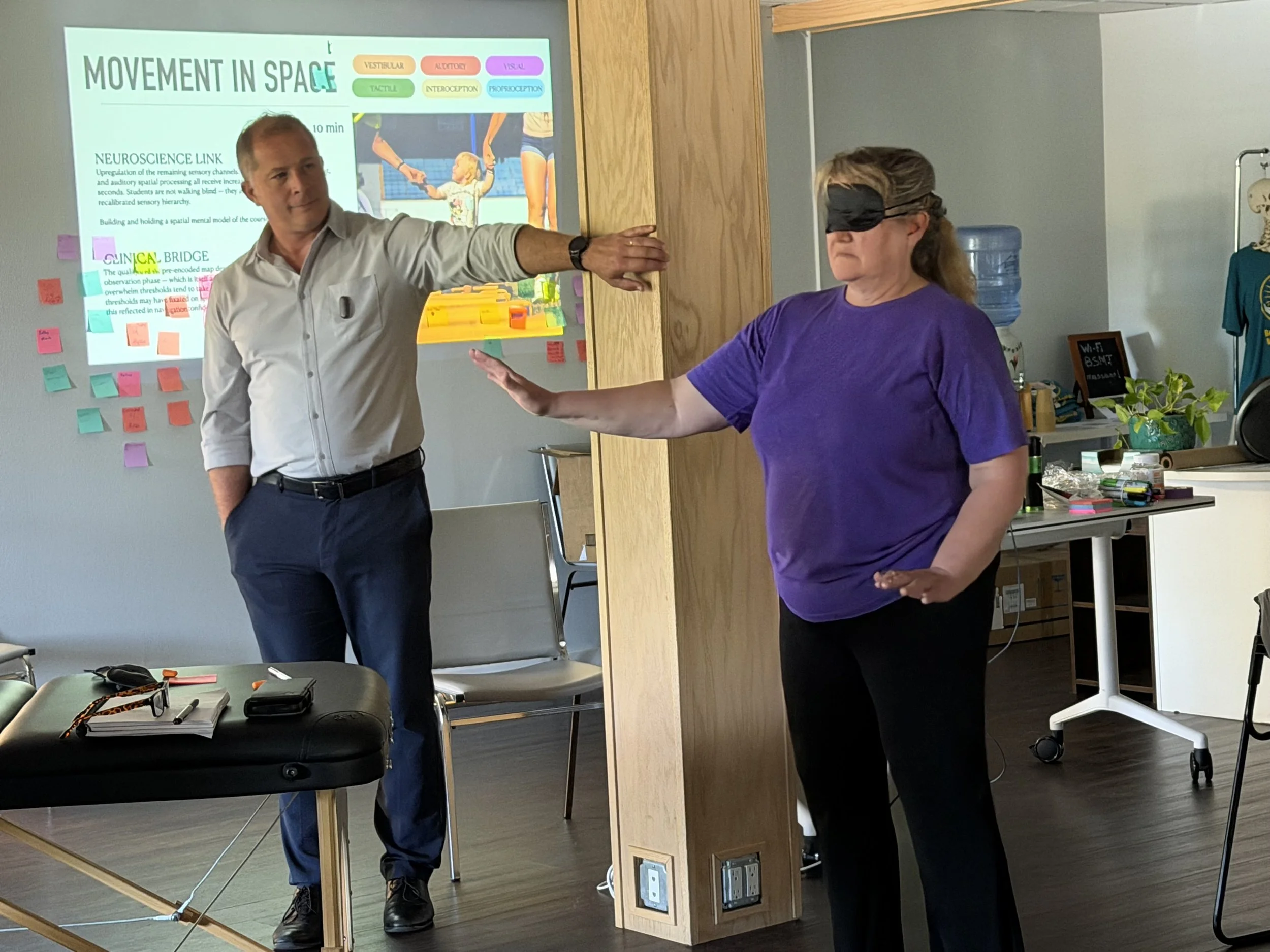
A fun experimental exercise about spatial awareness as it relates to our interoceptive, proprioceptive and vestibular self.
Interested in hosting a class or having me come teach at your school or for your association? Please contact me here: email