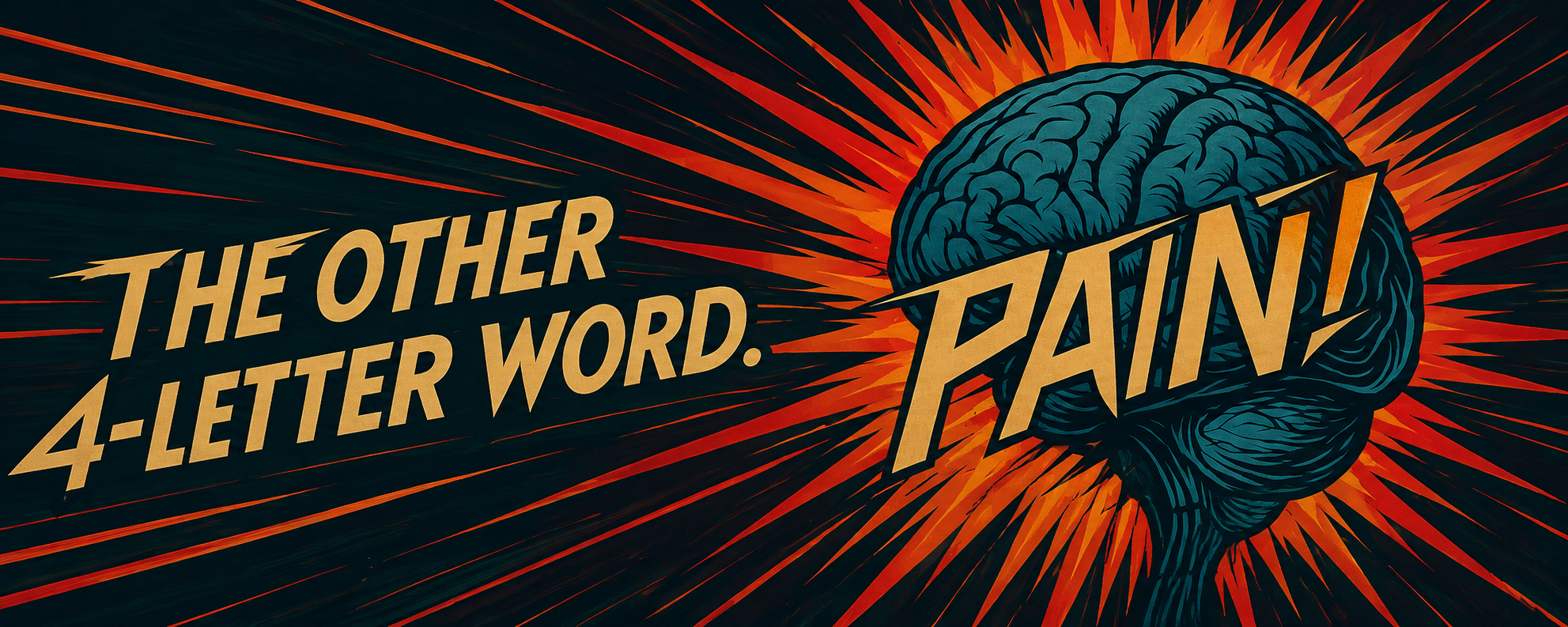
Four letters. We treat it like profanity — something to suppress, medicate away, or apologize for feeling. This class asks you to stop doing that, because the research says pain is not the enemy. It's a protective system doing exactly what it evolved to do, and most of what goes wrong with chronic pain happens after the original injury has healed, in how the nervous system learns to respond.
This is the live companion to my book of the same name — you don't need to have read it, but if you have, this class is where the ideas get demonstrated rather than just explained.
Pain is good — yes, actually
The class opens with a reframe most therapists have never been given permission to say out loud: pain is a beneficial, protective experience. It allows you to notice the many situations that aren't a real threat, before an actual injury forces the point. The alternative — numbing or avoiding pain repeatedly — doesn't make you tougher. It shrinks your window of tolerance through learning, so the alarm starts firing at a lower and lower threshold. That's the mechanism behind a huge share of chronic pain: not more damage, but a more sensitive alarm.
The smoke detector logic
Borrowed directly from evolutionary biology (Nesse, 2005): when the cost of a false alarm is cheap and the cost of missing a real threat is catastrophic, natural selection favors a system that goes off too often, not one that stays silent. Your nervous system is that smoke detector. It is supposed to over-fire sometimes. That's not a malfunction — it's the correct setting for an organism that needs to survive threats it can't fully evaluate in the moment.
Structural pain and debilitating pain are not the same thing
One is an actual insult to the body — real tissue damage. The other is remembered, predicted, or manufactured entirely by association: heartbreak, grief, fear of a behavior, fear of pain itself. Both are completely real. Only one of them is about the tissue. Confusing the two is where a lot of ineffective treatment plans start.
What the body does under sustained threat
The class walks through the actual cascade — CRH from the hypothalamus, ACTH from the pituitary, cortisol from the adrenal gland, hormone suppression, increased inflammatory cytokines, decreased insulin, and the fight-flight-freeze-fawn response underneath it — not as trivia, but so you can recognize when a client's system is stuck in a positive feedback loop that no amount of tissue work is going to interrupt on its own.
Emotion isn't a side effect of pain — it's a predictor of it
A Nature Neuroscience study followed forty volunteers with repeat brain scans over a year and predicted, with 85% accuracy, who would go on to develop chronic pain after an injury — based on emotional response, not tissue findings. As pain becomes chronic, the sensory component actually matters less and the emotional and behavioral component matters more. That's not a claim that pain is imaginary. It's a claim that treating only the tissue, this far into the process, is treating the smaller half of the problem.
Retiring the old scripts
The class is direct about language that needs to be dropped: "your pain is coming from X, fix that and you'll be pain-free," "your posture is causing your pain," "it's all in your mind, not something manual therapy can touch." Posture and pain correlate; they don't cause each other in any direct, established way. Movement is one of the most effective interventions available for pain, not a risk to be minimized. And pain being influenced by the brain doesn't mean it isn't also in the body — both need addressing, because the brain is, in fact, in the body.
Pain catastrophizing and fear-avoidance, named clearly
Habitually appraising any pain signal as extreme, avoiding activity that might trigger pain, carrying poor expectations for recovery — each of these independently predicts worse outcomes and higher re-injury risk, regardless of the original tissue finding. Fear of pain can be more disabling than the pain itself.
Who it's for
Licensed massage and manual therapists, at any experience level, who want a clearer framework for talking to clients about pain — and a good look at which of their own inherited scripts might be working against them.
Available as a 2-hour or 4-hour version. This can be taken on its own or as part of Creating Empathetic Touch, a series built around a better understanding of touch itself.
Learning Outcomes
Explain the evolutionary and neurological rationale for pain as a protective mechanism, rather than a malfunction to be eliminated.
Differentiate between structural pain (an actual insult to the body) and debilitating pain driven by memory, prediction, or association, and identify which clinical response fits each.
Describe the smoke detector principle of threat response, and apply it to explain why a nervous system's alarm can fire in the absence of tissue damage without that firing being inappropriate.
Identify the physiological cascade of sustained threat response (HPA axis activation, cortisol release, inflammatory cytokine increase) and its relevance to a client presenting with chronic pain.
Summarize the research linking emotional state to chronic pain development, including the predictive relationship between emotional response and pain outcome independent of tissue findings.
Recognize pain catastrophizing and fear-avoidance behavior in client presentation, and explain why each independently predicts worse recovery outcomes.
Replace outdated clinical language patterns (e.g., attributing pain directly to posture, promising a treatment will resolve pain, or dismissing pain as purely psychological) with language consistent with current pain science.
Apply the distinction between correlation and causation to commonly cited relationships in manual therapy (e.g., posture and pain) when communicating with clients.
IN-PERSON & VIRTUAL
2-hour NCBTMB approved continuing education class (NY Sponsorship approved and CE Broker approved)
Open to all healthcare practitioners licensed in Manual/Massage Therapy
Course ID(s): 70327690 (Live) Course ID: CE401015 (Distance Learning/Webinar)
Interested in hosting a class or having me come teach at your school or for your association? Please contact me here: email