Manual therapy does not fix concussions. The brain fixes the brain. Your job is to reduce threat, open a window of neurological calm, and help the client stress their way back to function — because concussion recovery isn't about rest anymore. It's about progressive, intelligent stress, and the old advice to sit in a dark room until symptoms disappear is now understood to sometimes make recovery worse, not better.
This 4-hour workshop teaches you exactly where your hands fit into that picture, and exactly where they don't.
What a concussion actually is
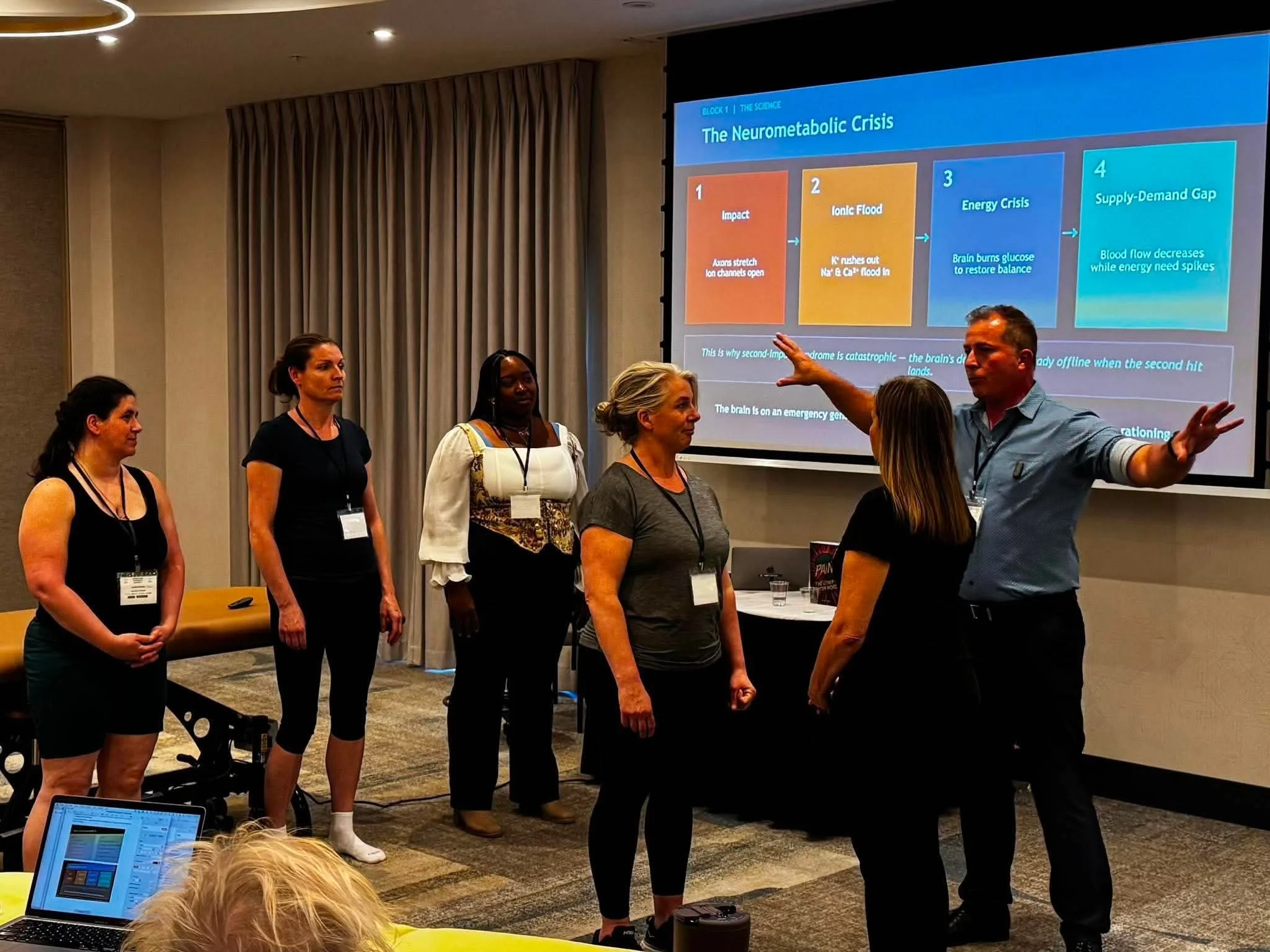
Not a bruise. A neurometabolic energy crisis: the impact stretches axons and forces open ion channels, potassium floods out, sodium and calcium flood in, and the brain burns glucose trying to restore balance — while blood flow to supply that glucose actually drops. The brain runs the rest of recovery on an emergency generator. Every sensory input costs more than usual. Symptoms are the rationing, not damage you can see on a scan. This is also why a second hit before recovery is so dangerous — the brain's defenses are already offline.
Where manual therapy actually works
Two real mechanisms, not "increased blood flow to the brain":
The cervicogenic connection. Suboccipital hypertonicity correlates directly with symptom severity and recovery time (Fakhran et al., 2016). The upper cervical spine feeds dense proprioceptive signal to the vestibular nuclei — distorted signal reads as threat, and threat means more symptoms.
Touch as threat modulation. Slow, non-threatening contact activates C-tactile afferents, down-regulates the threat response, and shifts the system toward parasympathetic dominance. That's the mechanism. It's not circulation.
Know your lane
The class draws a hard line between three concussion subtypes, and treats each one differently:
Cervicogenic-dominant — headache, neck pain, restricted ROM, suboccipital tenderness. This is primary manual therapy territory.
Vestibulo-ocular-dominant — dizziness, gaze instability, motion sensitivity. Manual therapy supports and reduces threat; the actual rehab is a referral to vestibular PT.
Physiologic/autonomic-dominant — exercise intolerance, fatigue, cognitive fog. You support autonomic regulation; graded aerobic exercise is the primary intervention, and it isn't yours to prescribe as treatment.
What you'll actually do
A four-step baseline assessment (modified BESS, symptom screen, cervical ROM, suboccipital palpation) run before and after treatment
A defined manual sequence: cranio-cervical decompression, upper cervical soft tissue work, vagal access points, and an optional thoracic finish — all slow, all inhibition-focused, none of it deep tissue to the cervical spine or cranium
Vestibulo-ocular drills, balance and dual-task loading, and interoceptive recalibration — taught explicitly as client homework you coach, not treatment you perform
A red-flag list and a real referral network: vestibular PT, neuropsychologist, sport medicine physician, mental health professional, and when to send someone straight to emergency
What this class won't tell you
It won't tell you that massage improves circulation to the brain, that dark-room rest is still the standard, or that manual therapy resolves a concussion on its own. The deck says plainly: the research on massage and concussion specifically is thin. Be humble, document your work, refer early, and expect the guidance to keep changing as the science moves.
Who it's for
Licensed massage and manual therapists working with concussion clients in general practice or sport. No prior concussion-specific training required.
Learning Objectives
• Identify common symptoms and neurophysiological changes associated with concussion and PPCS.
• Explain how manual therapy can influence sensory processing, threat modulation, and autonomic regulation.
• Perform basic propriosensory and vestibular drills appropriate for post-concussion care within massage therapy scope.
• Integrate interoceptive awareness strategies into treatment to support nervous system regulation and pain reduction.
• Apply a clinical decision-making model to safely progress manual therapy and movement-based interventions.
• Recognize red flags and appropriate referral situations (neurology, vestibular PT, neuropsychology, etc.).
• Develop a simple treatment progression combining manual therapy, sensory retraining, and client self-care practices.
IN-PERSON
4- hour NCBTMB approved continuing education class (NY Sponsorship approved and CE Broker approved)
Open to all healthcare practitioners licensed in Manual/Massage Therapy
Course ID(s): CE4027952
Interested in hosting a class or having me come teach at your school or for your association? Please contact me here: email