Your client isn’t average!
(Edited with the help of Claude AI)
A client is on your table with six months of low back pain. You've done the reading. You know what the reviews say about manual therapy for non-specific low back pain, and you know the effect sizes are modest and the confidence intervals are wide. You also know that this person slept badly for a year, is frightened of her own spine, and has been told by three practitioners that her pelvis is out of alignment.
So what do you do with the evidence?
There's a bad answer to that and a good one. The bad answer is to pick a team. One team cites papers at clients and treats research as a rulebook that overrides the person. The other abandons the evidence the moment it becomes inconvenient and calls that being patient-centered. Both are common in our profession. Both are a failure of reasoning dressed up as a philosophy.
The good answer takes longer to explain, which is why it loses arguments on the internet.
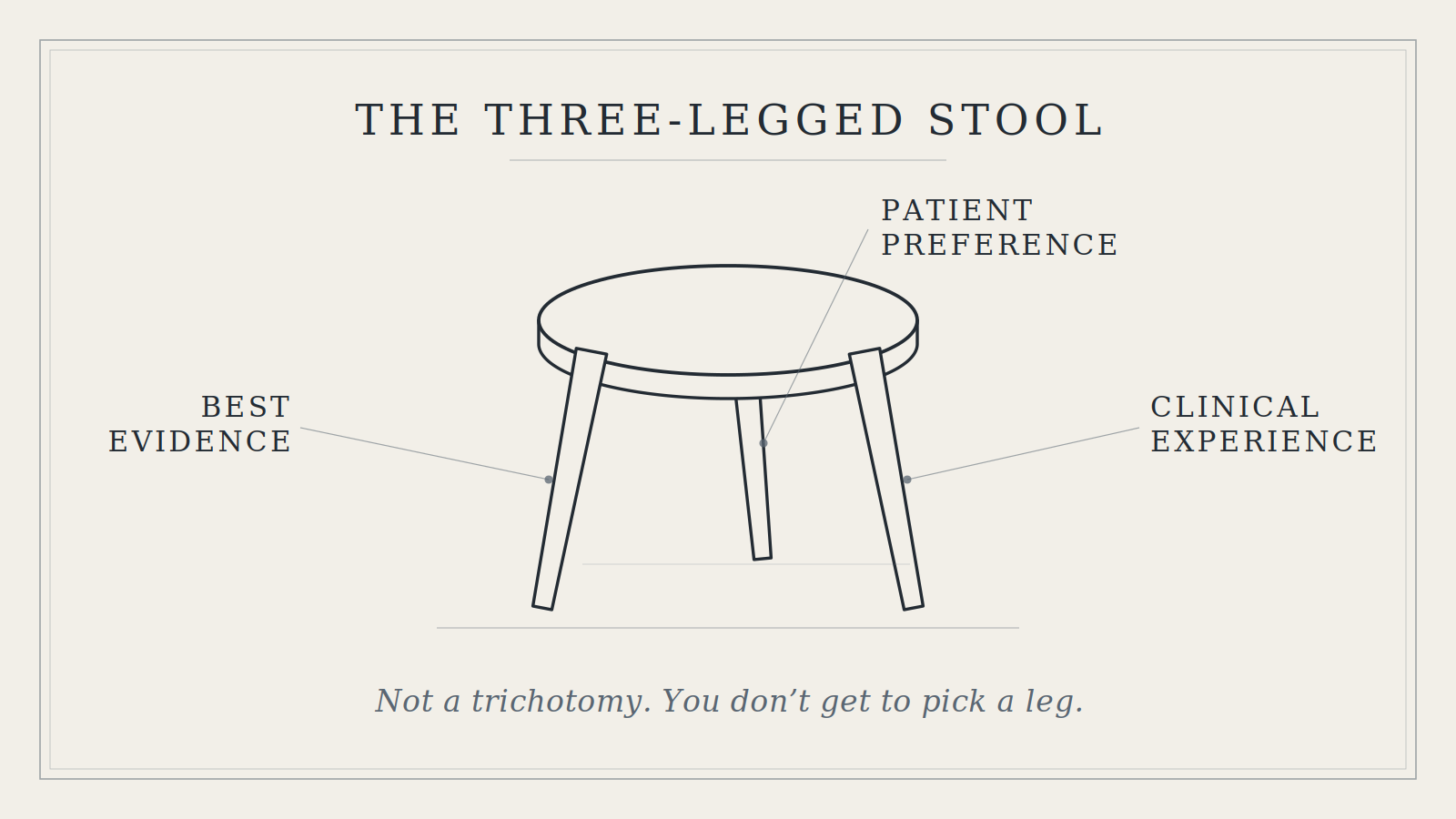
The stool, and the problem with the stool
Patient values were in evidence-based medicine from the beginning. Sackett's definition (a nice tribute to Sackett) — the one everyone quotes half of — described EBM as the "conscientious, explicit, and judicious use of current best evidence" in decisions about individual patients, and defined the practice of it as integrating clinical expertise with the best external evidence from systematic research. Three legs: best evidence, clinical experience, patient preference.
Sackett was explicit that this was not cookbook medicine. External evidence can inform clinical expertise but never replace it, and it is that expertise which decides whether the external evidence applies to this patient at all.
Most of us pick a leg. We lean on whichever one justifies what we already wanted to do, then call it evidence-based practice. The therapist who only reads studies and the therapist who only trusts their hands are making the same error in opposite directions. It isn't a trichotomy. You don't get to choose one.
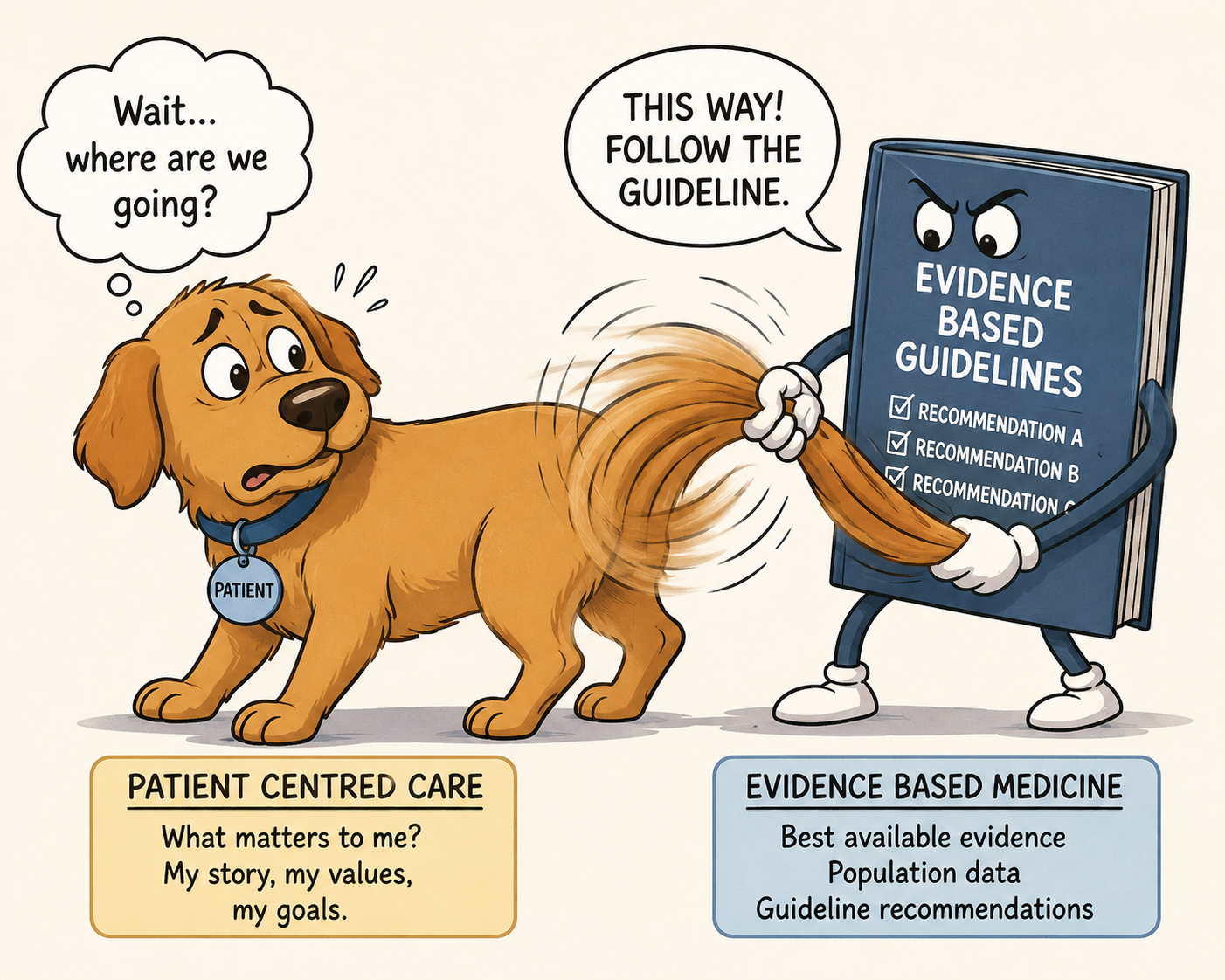
This isn't a fringe complaint. In 2014 a group of senior figures from inside the EBM movement asked, in the BMJ, whether their own movement was in crisis. Their charge sheet: the evidence-based quality mark misappropriated by vested interests, a volume of guidelines that had become unmanageable, statistically significant benefits that are marginal in practice, and inflexible rules producing care that is management-driven rather than patient-centred. Their example is a 74-year-old put on a high-dose statin because a clinician applied a fragment of a guideline uncritically, then developing muscle pain that stopped her exercising.
This is what we would call ‘the tail wagging the dog’.
Their proposed fix was a return to what they called real evidence-based medicine: individualised, built on expert judgment rather than rule-following, grounded in a strong clinician-patient relationship, with decisions shared through actual conversations.
Read that list again. Every item on it is what we would call patient-centered care. The people who built EBM are telling us that the version of it that ignores the patient isn't a purer form of the thing. It's a broken form of it.
So why doesn’t the evidence answer your clinical question
There are three problems that help us understand this, and they survive even when we behave well.
1 - Volume
Greenhalgh and colleagues cite one audit that found that a single 24-hour medical intake caring for 18 patients with 44 diagnoses between them had 3,679 pages of relevant national guidance attached to it — an estimated 122 hours of reading.. Nobody (and I really believe it is nobody) is doing that amount of reading. The question isn't whether you can keep up. It's what care you offer given that you can't.
2 - Inference
I know this paper is old for reference but it’s a good one. Di Fabio made this argument in 1999 and it hasn't aged a day. The literature studied acute symptoms; your client is chronic. Ding ding ding ding! PAY ATTENTION TO THAT LAST SENTENCE AGAIN! (With what we know about pain science today this matters significantly.) It ran daily sessions for six weeks; clients gets four weeks. It used elite athletes; yours plays beer-league. Every gap between the study population and the person in front of you has to be crossed by inference, and inference is not proof. A clear demonstration of this is a RAND panel from 1996. Nine experts — chiropractors, a family physician, a neurosurgeon, an orthopaedic surgeon, neurologists — were handed the same review of more than 500 papers on cervical manipulation and mobilization, then asked to rate 1,436 clinical indications. They rated 16% appropriate. They rated 43% inappropriate. And they rated 41% uncertain — not wrong, not right, genuinely unresolved on the evidence available. Sit with that middle number. Four in ten clinical situations, and the best-informed panel anyone could assemble could not tell you what to do. That isn't a failure of the panel. It's the actual shape of the evidence base you're working from, and no amount of reading will collapse it into a rule.
3 - Fit
Murphy and colleagues laid out what to check when research doesn't seem to translate. Who were the participants, really — not per the abstract, per the methods? Were people with comorbidities excluded, when comorbidities are most of your caseload? What non-specific effects might be driving the result? Does the authors' interpretation actually match what their design can support — did pain drop because of the intervention, or merely during it? (As a side note this is one more reason why reading and understanding research is so valuable for any healthcare practitioner. An abstract or conclusion is insufficient to understand a paper; the method, funding and much more are needed to fully understand research.)
And underneath all of it: the mean or average is not a person. Fisher and colleagues argued in 2018 that group-level findings don't reliably generalise to individuals — it's not a rounding error, it's a structural threat. Your client is n=1. You cannot hand her the average.
What patient-centered care isn't
It isn't doing whatever the client asks. Wants and needs are different things, and conflating them is not respect.
It also isn't replacing the clinical account with the client's account. The goal is a story that makes both biological and biographical sense — not swapping one story for the other. Done badly, patient-centered care is a customer service model wearing clinical vocabulary: agreeable, unfalsifiable and useless the moment someone wants something that will hurt them. Done properly, it's an ethical stance toward the person as capable — defined by who they are rather than by what they've been diagnosed with — delivered through listening, alliance, agreed expectations, honest communication of evidence, and shared decisions.
It has an outcomes literature too, though I'd hold it loosely.. A 2023 survey of hospital inpatients found that people who reported more patient-centered care also reported better physical and mental health. This is exactly what I want to be true, which is the first reason I decided to slow down and read this paper a few times. Almost everyone in the survey rated their care near the top of the scale. This means there was very little variation left to explain anything with.. The care ratings and the health ratings came from the same person, on the same form, at the same moment — one good hospital stay can produce both these results. And it's a snapshot, so nothing in it tells us the care came first, before the survey was completed.
The part of that study that I actually want to lean into is the part I am far less excited about, simply because it helps me move away from my personal bias. People who reported more patient-centered care were also less likely to report being steered into repeat tests, extra prescriptions, or being discharged and readmitted. Note what this means — more time and engagement did not produce more billable intervention. It produced less. Their survey responses are based on behaviour somebody else performed, not a feeling being rated, and it's much harder to explain away, which is why it is more valuable.
If you noticed that I wanted the first finding more than the second one, that's the whole point of this post and exercise. How do we integrate potentially opposing values between EBM and PCC, even when the findings do not confirm our own biases.
Gin and tonic
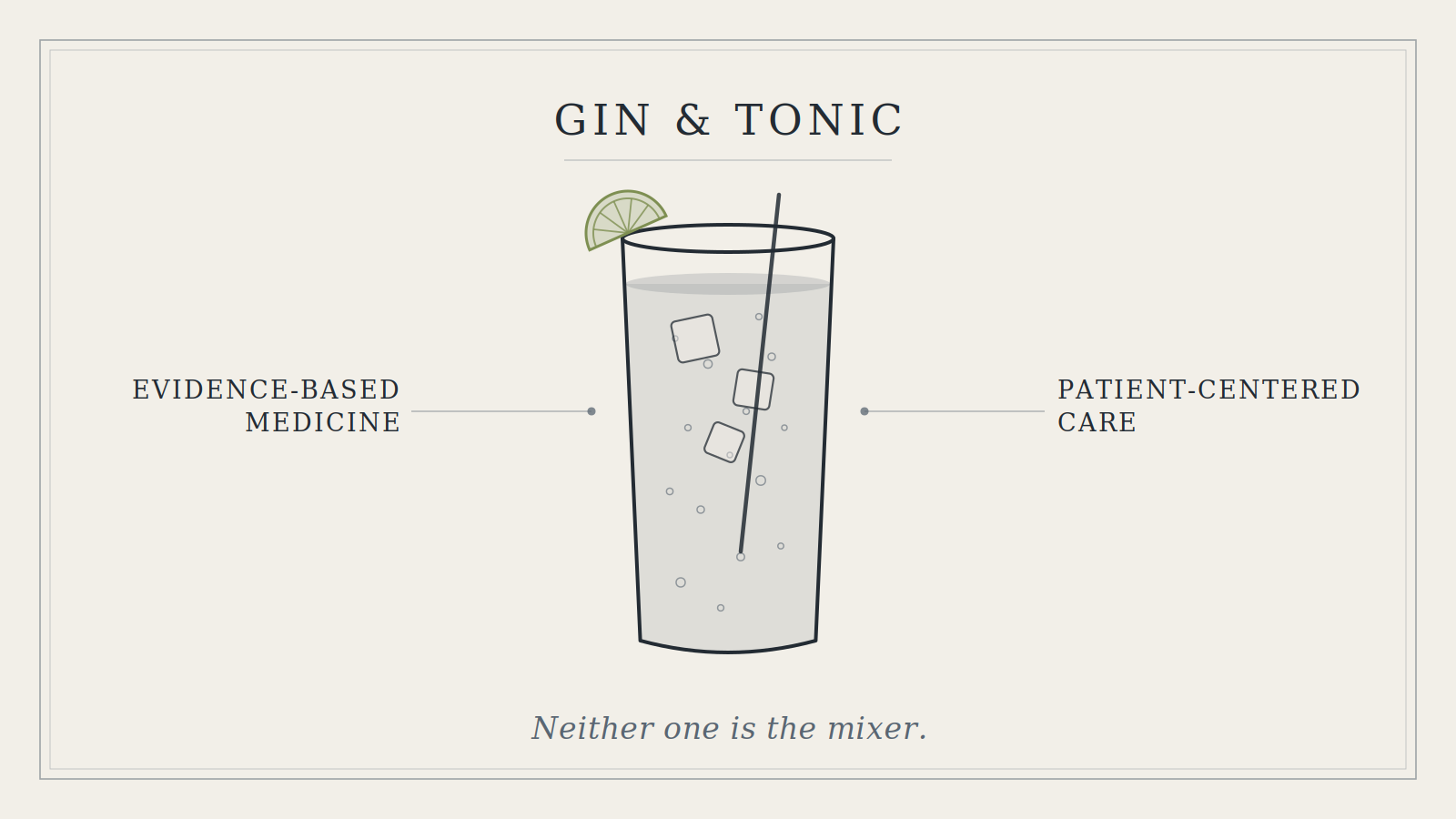
(Sorry for those who don't drink, or don't appreciate the analogy.. It was the best one that I could think of and it happens to be my favourite drink.)
Here's the resolution: EBM and PCC should work like gin and tonic. Neither is the mixer. You're not diluting the evidence with humanity, or humanising a fundamentally cold science. Separately they're both a bit hard to drink.
Practically, that means treating clinical reasoning as probability rather than proof. You generate a hypothesis abductively in the first minutes (intake), refine it inductively and deductively as you gather information (assessment), test it with an intervention (treatment), and update on the response (re-assessment). If the client improves, the hypothesis was probably accurate. Not proven — probably accurate. (This is such an important conclusion. Just because your client had change -for better ideally- this doesn’t mean you were right. You were probably right but take a step back and be more reflective and humble about the intervention.)
Riley and colleagues make the case for abandoning the dream of a linear framework that identifies the only right answer for the person in front of you, and they're blunt about what fills the gap when we pretend otherwise: confirmation bias, recall bias, appeals to authority, and a professional culture where everyone's system works.
Which brings us back to Di Fabio's line. We need to 'abandon the quest for absolute truth' and use clinical research — balanced between evidence-based medicine and patient-centred care — to build a reasoned philosophy of patient care.
I am sorry…
…but there’s no formula. Nobody is going to hand you a rule that tells you when to follow the paper and when to follow the person, and anyone selling you one is selling a shortcut you'll regret. (Think of all the classes you have ever taken that sell you protocols and not clinical reasoning.)
What you can build is a reasoned philosophy of care — dynamic rather than fixed, revisable when the evidence changes, and structured so the research informs your decisions without overwriting the human being it exists to serve. That's harder than picking a team. It's also the actual job.
References
Di Fabio RP. Myth of evidence-based practice. J Orthop Sports Phys Ther. 1999;29(11):632-634.
Fisher AJ, Medaglia JD, Jeronimus BF. Lack of group-to-individual generalizability is a threat to human subjects research. PNAS. 2018.
Greenhalgh T, Howick J, Maskrey N; Evidence Based Medicine Renaissance Group. Evidence based medicine: a movement in crisis? BMJ. 2014;348:g3725.
Masic I, Miokovic M, Muhamedagic B. Evidence based medicine — new approaches and challenges. Acta Inform Med. 2008;16(4):219-225.
Murphy MC, Gibson W, Moseley GL, Rio EK. Are you translating research into clinical practice? What to think about when it does not seem to be working. Br J Sports Med. 2021;55(12):652-653.
Riley SP, Petrosino C, Cleland JA. Do you really have the only, right, or best evidence-based approach to treat your patients? J Man Manip Ther. 2020;28(5):251-253.
Sackett DL, Rosenberg WMC, Gray JAM, Haynes RB, Richardson WS. Evidence based medicine: what it is and what it isn't. BMJ. 1996;312(7023):71-72.
Yu C, Xian Y, Jing T, et al. More patient-centered care, better healthcare: the association between patient-centered care and healthcare outcomes in inpatients. Front Public Health. 2023;11:1148277.
Allen D, Harkins KJ. Too much guidance? Lancet. 2005 May 21-27;365(9473):1768. doi: 10.1016/S0140-6736(05)66578-6. PMID: 15910948.
Coulter ID, Hurwitz EL, Adams AH, et al. The Appropriateness of Manipulation and Mobilization of the Cervical Spine. Santa Monica, CA: RAND Corporation; 1996. MR-781-CCR.
Turner RE, Archer E. Patient-centred care: The patients' perspective - A mixed-methods pilot study. Afr J Prim Health Care Fam Med. 2020 Oct 9;12(1):e1-e8. doi: 10.4102/phcfm.v12i1.2390. PMID: 33054274; PMCID: PMC7564840.