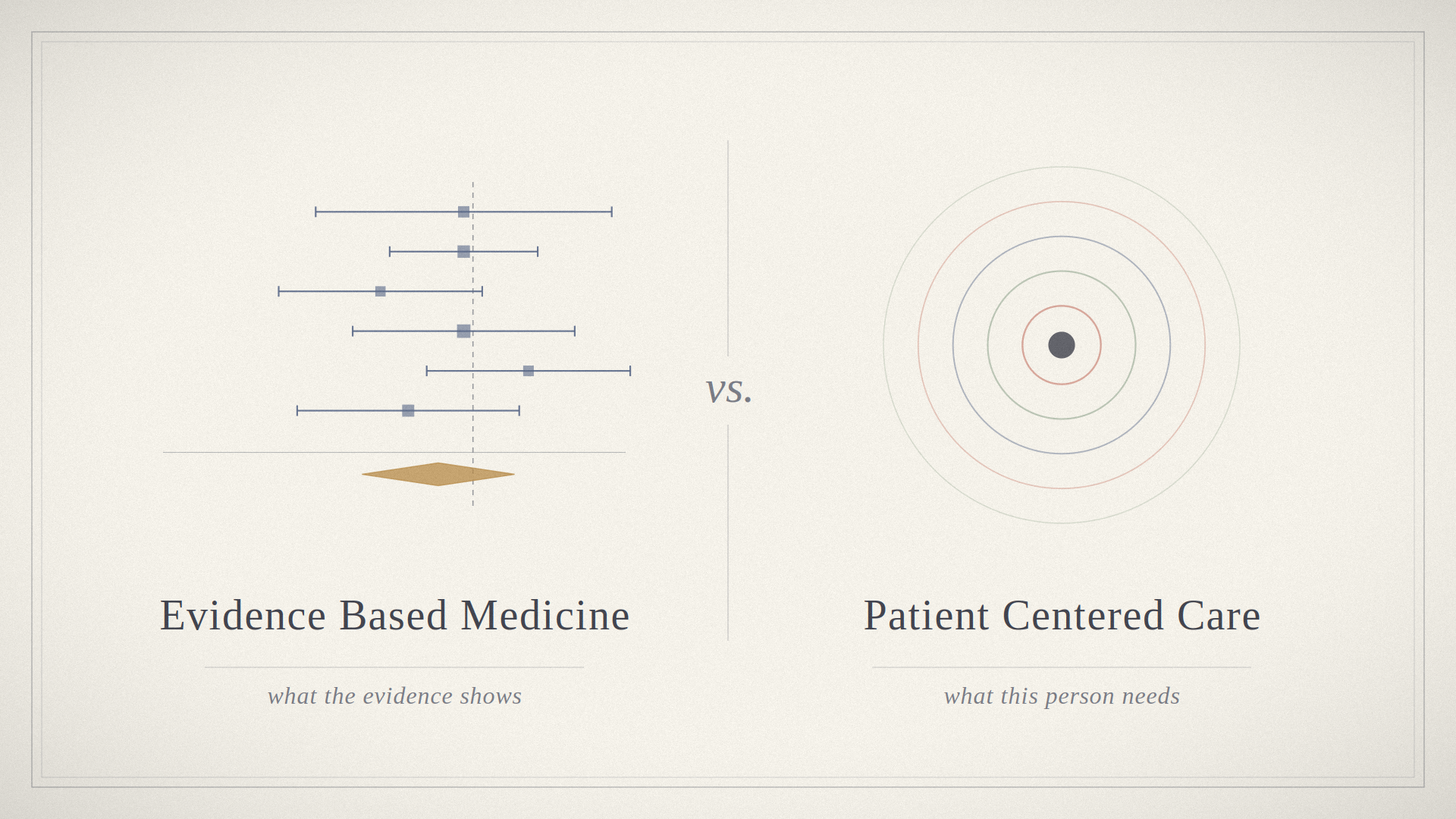
A client comes in with back pain. You've read the research. You know what the systematic reviews say about manual therapy for non-specific low back pain, and you know the effect sizes are modest. You also know this person, sitting in front of you, is not the average of a trial population. They're one data point — and data points move.
So which do you follow?
That question has a bad answer and a good one. The bad answer is to pick a side: become the therapist who cites papers at clients, or the therapist who abandons evidence the moment it's inconvenient. Both are common. Both are a failure of reasoning dressed up as a philosophy.
This class is about the good answer.
The problem with patient-centered care
Patient-centered care isn't doing whatever the client asks. It isn't replacing the clinical story with the client's story. It's an approach that treats the person as a capable individual rather than a diagnosis — respectful, culturally responsive, and built on shared decision-making. It has real barriers: workload, compassion fatigue, organizational culture, power hierarchies, and the fact that listening properly takes time nobody schedules.
Done badly, PCC is a customer service model with a clinical vocabulary.
Done well, it's the only mechanism you have for finding out whether the evidence applies to the person in front of you.
What we'll cover
What EBM actually is, where it came from, and what Sackett meant by judicious
The three-legged stool, and why picking one leg is the most common error in the profession
Why evidence rarely answers your clinical question — and how to ask one it can answer
Confirmation bias, with a live debate exercise: can you argue the case against your own preferred modality?
Averages, probability, and where your individual client sits relative to trial data
What patient-centered care is, what it isn't, and the barriers that make it hard to deliver
Clinical reasoning as probability: deductive, inductive, and abductive thinking at the table
Is the client's story evidence? (For research, no. For care, yes — and that distinction matters)
Practical integration: shared decision-making, therapeutic alliance, and communicating evidence in language a client can actually use
Remember!
There is no formula here. Nobody hands you a rule that tells you when to follow the paper and when to follow the person. What you can build is a reasoned philosophy of care that's dynamic rather than fixed — one that lets evidence inform your decisions without letting it overwrite the human being it's supposed to serve. That's the work.
Who it's for
This class is designed for licensed massage therapists and manual therapists at any experience level. No research training required — the class is designed to give you tools for appraising and applying evidence, not to make you a researcher.
This can be taken on its own or as part of Creating Empathetic Touch, a series built around a better understanding of touch itself.
There is a major problem with evidence
Sackett defined evidence-based medicine as the conscientious, explicit, and judicious use of current best evidence in decisions about individual patients — and built it on three legs: best evidence, clinical experience, and patient preference. Most of us pick a leg. We lean on the one that justifies what we already wanted to do, and call it evidence-based practice.
There's a deeper problem. The evidence doesn't answer your question. It answers the question the researchers asked, which is rarely the same one. Does manual therapy work? isn't a question — it's a shape where a question should be. Work for what? For whom? At what point in their presentation? And the mean of a trial is not a person. It's the average of people, and you cannot hand the average to the client on your table.
Learning Outcomes
Apply Sackett's three-part definition of evidence-based medicine — best evidence, clinical experience, and patient preference — to identify when a clinical decision is leaning on only one or two of the three, and adjust accordingly.
Distinguish between what a research study's average result indicates and what it predicts for an individual client, and use that distinction to communicate evidence-based findings without overstating their certainty for the person on the table.
Integrate patient-centered principles — shared decision-making and therapeutic alliance — with research evidence to build a treatment approach when the two appear to conflict, rather than defaulting to one at the expense of the other.
IN-PERSON & VIRTUAL
1-hour NCBTMB approved continuing education class (NY Sponsorship approved and CE Broker approved)
Open to all healthcare practitioners licensed in Manual/Massage Therapy
Course ID(s): CE4020628 (Live) · CE4023031 (Distance Learning/Webinar)
Interested in hosting a class or having me come teach at your school or for your association? Please contact me here: email